
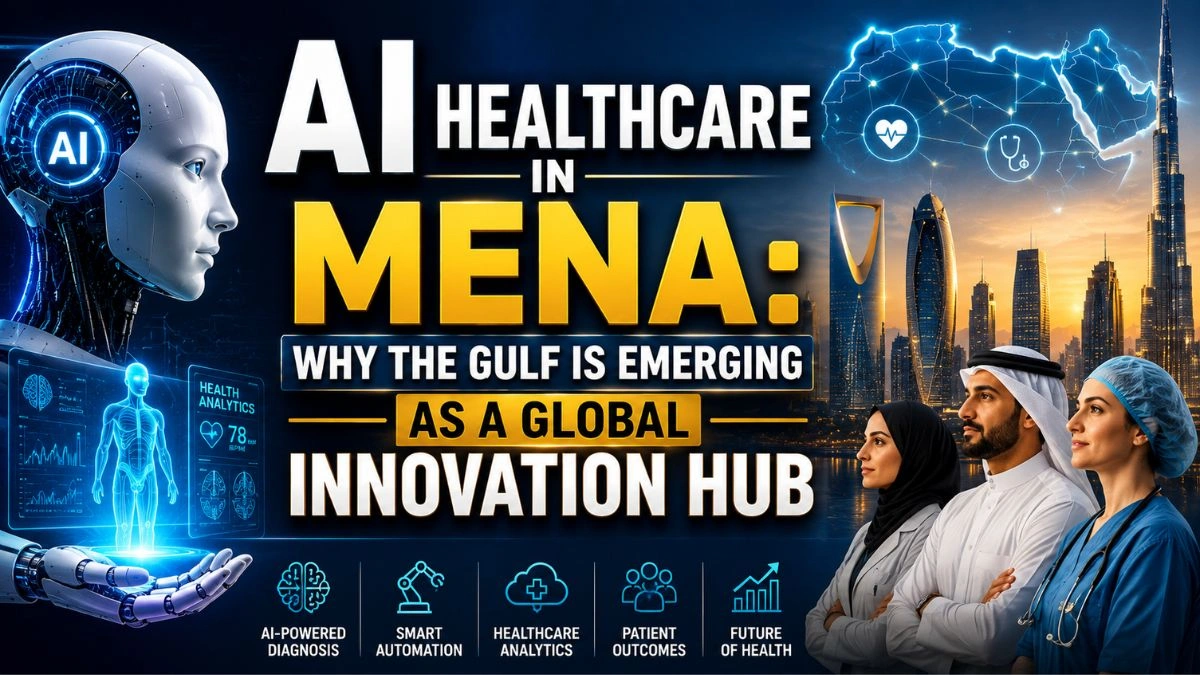
The Middle East and North Africa (MENA) region—especially Gulf countries—is rapidly becoming a compelling destination for building AI-driven healthcare solutions. Strong government initiatives, growing investment, and urgent clinical needs are creating a unique environment that differs significantly from Western markets.
Government Vision and Strategic Push
Countries like Saudi Arabia and United Arab Emirates are prioritizing AI in healthcare through large-scale national programs. Saudi Arabia’s Vision 2030 and the UAE’s National AI Strategy are integrating digital health into core policy frameworks, enabling coordinated procurement and faster adoption.
This centralized approach gives the region an advantage, as governments can implement solutions at scale—something often harder to achieve in fragmented Western healthcare systems.
Market Growth and Investment Potential
The AI healthcare sector in MENA is expected to expand significantly—from around $0.6 billion today to potentially $15 billion by 2035. This growth is supported by substantial funding from sovereign wealth funds, public initiatives, and rising private investments.
However, the key challenge remains whether this financial backing will translate into meaningful clinical outcomes and sustainable business models
Current Deployments and Use Cases
AI is already being implemented across the region at scale. The UAE has developed national AI diagnostic systems capable of processing millions of tests with real-time insights. Meanwhile, Saudi Arabia’s healthcare transformation programs are embedding AI into clinical workflows through platforms like Sehhaty.
Common applications include:
- AI-powered triage systems
- Remote patient monitoring
- Automated diagnostic imaging
- AI-driven insurance claim processing
These solutions are either operational or in advanced pilot stages across the Gulf and North Africa.
Rising Clinical Demand
Healthcare systems in MENA are under pressure. According to Elsevier’s 2026 Clinician of the Future report, three out of five clinicians in the region are seeing increased patient volumes compared to the previous year. Additionally, over half report fatigue affecting their performance.
This growing strain is accelerating demand for AI tools that can improve efficiency and reduce workload.
The Leapfrog Advantage
MENA may replicate the “leapfrog” effect seen in mobile payments—where regions skipped traditional infrastructure and adopted modern solutions directly. Similarly, limited legacy systems in healthcare allow faster adoption of AI technologies.
Three factors define this advantage:
Challenges and Barriers
Despite the optimism, adoption is still uneven. Only 21% of clinicians in the region frequently use AI-specific clinical tools, compared to 41% in North America. Additionally, about a quarter of clinicians do not use such tools at all.
Concerns about AI reliability, ethics, and trust remain significant. Regulatory frameworks and data governance policies are evolving but vary across countries, creating uncertainty.
Moreover, expertise and infrastructure are concentrated in key hubs like Dubai, Abu Dhabi, and Riyadh, making broader regional scaling more complex.
The Role of Hardware Innovation
Beyond software, physical technologies are becoming crucial. Companies like Paragraf are developing advanced graphene-based sensors that enhance data collection accuracy for AI systems.
These sensors can detect biological signals and magnetic changes in real time, improving diagnostic precision. As noted by Forat El-Sayed, the future of AI healthcare depends heavily on such high-quality data inputs.
Conclusion
MENA is positioning itself as a powerful player in AI healthcare innovation, driven by strong policy support, ample funding, and pressing healthcare demands. While challenges like regulation, trust, and adoption persist, the region’s ability to deploy solutions quickly gives it a competitive edge. As both software and hardware ecosystems evolve, MENA’s healthcare AI landscape is set to become one of the most dynamic globally.