
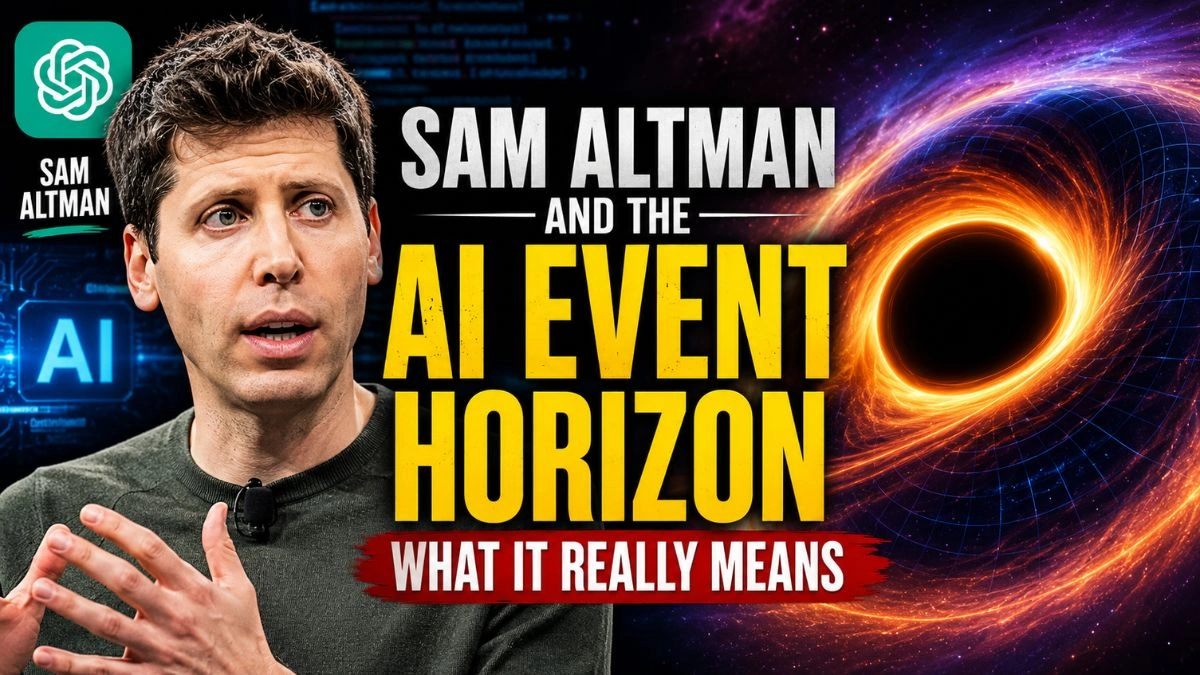
A recent statement by Sam Altman has sparked intense discussion across the tech world. He suggested that humanity has already crossed the “event horizon” of artificial intelligence—an idea that sounds both fascinating and unsettling. But what does this phrase actually imply for the future of AI?
Understanding the “Event Horizon” Concept
The term “event horizon” originates from astrophysics, referring to the boundary around a black hole beyond which nothing can escape. Applied to AI, it symbolizes a point of no return—a stage where technological progress becomes unstoppable and difficult to control.
Altman’s statement hints that AI development may have reached such a tipping point, where its evolution continues regardless of human attempts to slow or regulate it.
AGI vs ASI: The Real Concern
To understand the deeper implications, it’s important to distinguish between current AI and more advanced forms:
- Artificial General Intelligence (AGI): Systems capable of performing a wide range of tasks at human-level intelligence, including reasoning, learning, and adapting without retraining.
- Artificial Superintelligence (ASI): A hypothetical stage where AI surpasses human intelligence in every possible way, solving complex problems and innovating beyond human comprehension.
While today’s AI tools—like chatbots and recommendation systems—are still narrow in scope, AGI and ASI represent the transformative (and potentially disruptive) future often depicted in science fiction
Why Altman’s Statement Matters
Altman did not claim that AGI has already been achieved. Instead, his perspective suggests that we are now on an irreversible trajectory toward it. He describes this potential future as a “gentle singularity,” implying gradual and manageable change rather than sudden disruption.
This view is supported by rapid advancements in technologies such as:
- Large language models
- Voice synthesis systems
- Autonomous AI agents
- Multimodal AI platforms
Each breakthrough accelerates progress, creating momentum that builds on itself.
Debate Within the AI Community
Not all experts agree with Altman’s outlook. Opinions vary widely:
- Some believe AGI is still decades away
- Others predict it could emerge by the early 2030s
- A few argue it may never be achievable
For example, Lance Eliot has pointed out that definitions and timelines for AGI often shift, making predictions difficult to interpret.
This lack of consensus highlights the uncertainty surrounding AI’s future.
Is This Insight or Strategic Messaging?
There is also speculation that Altman’s statement may be partly strategic. As the leader of OpenAI, generating conversation around AI keeps the topic—and his organization—at the center of global attention.
Some critics argue that the phrase “event horizon” is intentionally vague. It creates intrigue without committing to a clear prediction, allowing for multiple interpretations while avoiding direct criticism.
A Broader Perspective
Despite the dramatic wording, the core idea may not be entirely new. Many already recognize that AI is advancing rapidly and could eventually lead to more powerful systems like AGI.
As former U.S. President Franklin D. Roosevelt once noted, expert opinions often differ widely—a sentiment that applies perfectly to today’s AI debate.
Conclusion
Sam Altman’s “AI event horizon” comment has captured global attention, but its meaning remains open to interpretation. While it highlights the accelerating pace of AI development, it does not definitively confirm that humanity has lost control over technology.
Instead, it reflects ongoing uncertainty, mixed expert opinions, and the complex reality of predicting AI’s future. Whether viewed as a genuine warning or a thought-provoking statement, it underscores one clear fact: AI’s evolution is advancing faster than ever, and its long-term impact remains uncertain.