
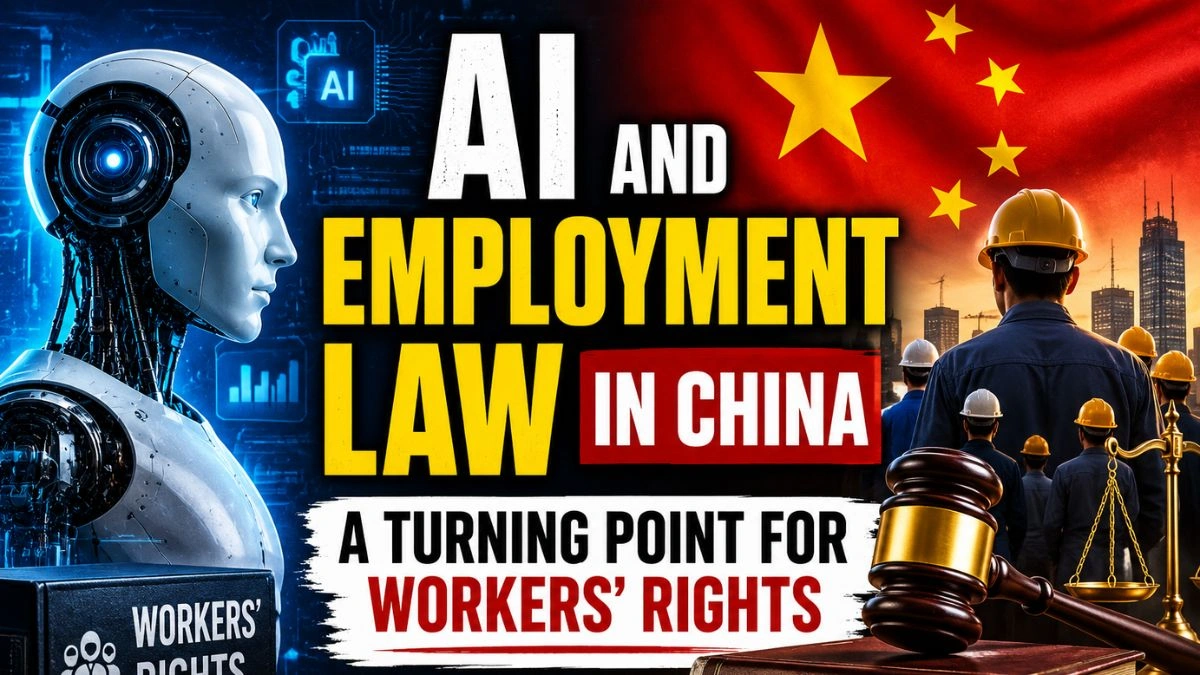
A recent legal decision in China has reignited the global debate over artificial intelligence (AI) and its impact on employment. Courts have clarified that replacing human workers with AI alone does not justify termination, setting a significant precedent in labor law.
Landmark Court Ruling in Hangzhou
The case was decided by the Hangzhou Intermediate People’s Court, often located in what is considered China’s Silicon Valley. A senior technician, identified as Zhou, discovered that AI systems were gradually taking over his responsibilities, including filtering illegal content and matching user queries.
The company offered Zhou compensation of 311,695 yuan (around $45,350) and a lower-paying role with a reduced monthly salary of 15,000 yuan, compared to his previous 25,000 yuan. Zhou refused and pursued legal action.
Labor arbitration ruled in his favor, declaring the dismissal unlawful. Subsequent appeals by the company were rejected, reinforcing the initial decision.
Legal Reasoning Behind the Decision
Chinese labor law permits termination only under “significant changes in objective conditions,” such as mergers or relocations. The court concluded that adopting AI does not fall into this category. Furthermore, the employer failed to prove that fulfilling the employment contract had become impossible.
A similar case in Beijing in December 2025 reached the same conclusion when a data collector was replaced by automation. The dismissal was also ruled illegal, strengthening the emerging legal framework.
Growth of China’s AI Industry
These rulings come as China’s AI sector rapidly expands, currently valued at over 1.2 trillion yuan ($175 billion) with more than 6,200 companies involved. Projections suggest that AI adoption could exceed 90% market penetration by 2030.
To balance technological growth with employment, China introduced 72 new professions between 2021 and 2025, including over 20 AI-related roles such as AI trainers, robot data collectors, and content creators.
Broader Debate on AI and Jobs
Global experts continue to debate AI’s role in employment. Economist Daron Acemoglu argues that companies often use automation to cut labor costs rather than improve productivity. Meanwhile, historian Yuval Noah Harari warns about a future where large segments of society may lose economic relevance.
Chinese leadership, including Xi Jinping, acknowledges both the opportunities and risks of AI, emphasizing the need for regulation.
Implications for Workers and Companies
Legal experts stress that while companies can benefit from AI efficiency, they must not transfer the burden onto employees. The rulings signal that technological advancement must operate within a legal and ethical framework.
As automation continues to reshape industries, the focus is shifting toward managing workforce transitions, ensuring fair compensation, and redefining labor relationships.
Conclusion
China’s recent court decisions mark a crucial step in defining the boundaries between innovation and workers’ rights. While AI adoption is accelerating, these rulings establish that employee protection cannot be overlooked. The balance between technological progress and legal accountability will shape the future of work, not only in China but globally.