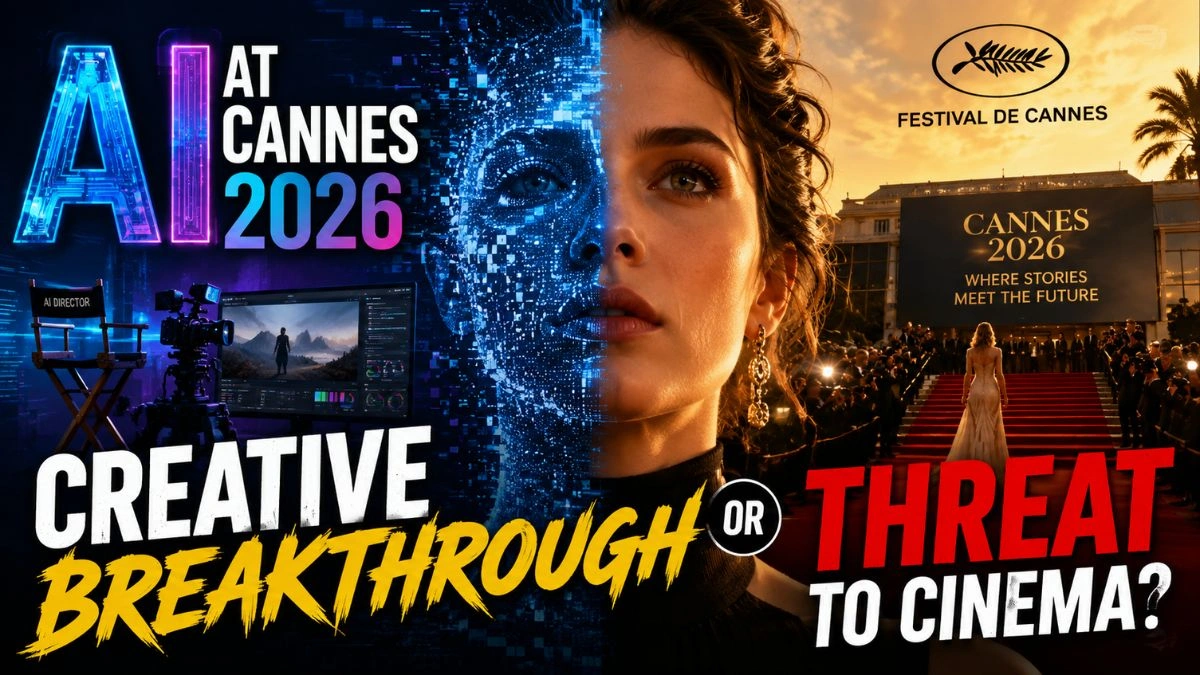
At the 2026 Cannes Film Festival, artificial intelligence (AI) emerged as the most debated topic across panels, beachside summits, and exclusive yacht gatherings. Industry leaders, filmmakers, and tech innovators clashed over whether AI represents a transformative creative tool or a serious risk to traditional filmmaking.
Growing Influence of AI in Filmmaking
Director Darren Aronofsky highlighted how AI is often misunderstood. He explained that AI is not a single concept but a broad term covering various technologies—from conversational tools to advanced image generation systems.
Through his studio, Primordial Soup, Aronofsky has collaborated with Google DeepMind on innovative projects like Goodnight Lamby. He emphasized that AI serves as a supportive tool rather than a replacement for human creativity.
One example he shared involved using AI to digitally create a realistic newborn baby in a film scene, eliminating the need for an actual infant on set. According to him, such applications solve ethical and logistical challenges while enabling storytelling that might otherwise be impossible.
Industry Adoption and Experimentation
AI adoption is accelerating across the film industry. At Cannes, filmmaker Chuck Russell introduced AI-powered science fiction films produced by his company Neumorphic AI. He described AI as a tool that significantly expands creative possibilities.
Similarly, Steven Soderbergh showcased his documentary John Lennon: The Last Interview, which used AI for around 10% of its visuals. These sequences included symbolic imagery designed to enhance storytelling rather than mislead audiences. Soderbergh compared AI to traditional visual effects (VFX), stressing transparency in its usage.
Divided Opinions Across Hollywood
Despite growing adoption, AI remains highly controversial.
- Guillermo del Toro strongly rejected AI, stating he would “rather die” than use it in filmmaking.
- In contrast, Reese Witherspoon has actively invested in AI storytelling technologies.
- Actor Seth Rogen criticized AI-assisted writing, dismissing it as creatively weak.
Meanwhile, the late Val Kilmer appeared posthumously in a trailer recreated using AI, further fueling ethical debates.
Economic Impact and Industry Transformation
Studio executives believe AI could significantly reduce production costs. By using hybrid AI techniques, multiple mid-budget films could be produced at the cost of a single blockbuster.
However, concerns remain about job displacement. The introduction of Tilly Norwood—an AI-generated “actress”—sparked backlash from actors and labor unions, highlighting fears about the future of human performers.
Rules, Ethics, and Industry Standards
The Academy of Motion Picture Arts and Sciences has attempted to regulate AI usage. New guidelines require that performances must be demonstrably human. However, ambiguity remains.
For instance, AI was used to refine Adrien Brody’s accent in The Brutalist, raising questions about whether such enhancements affect award eligibility.
Additionally, Cannes has banned fully AI-generated films from its main competition, signaling caution while still allowing partial AI integration.
AI as a Creative Tool vs. Human Essence
Many industry figures view AI as part of cinema’s natural evolution.
- Peter Jackson compared AI to early filmmaking techniques like stop-motion, emphasizing that creativity still depends on human imagination.
- Demi Moore acknowledged that AI is inevitable but insisted it cannot replace the emotional depth and “human soul” in storytelling.
Aronofsky echoed this sentiment, stating that big-budget films featuring stars like Leonardo DiCaprio will continue to thrive alongside AI-enhanced productions.
Conclusion
AI is undeniably reshaping the film industry, offering new tools that expand creative possibilities and streamline production. However, its rise also raises serious ethical, artistic, and economic concerns. While some filmmakers embrace AI as an evolution of cinematic technology, others fear it could undermine the human essence of storytelling. Ultimately, the future of AI in cinema will depend on how responsibly and creatively it is used, balancing innovation with authenticity.