
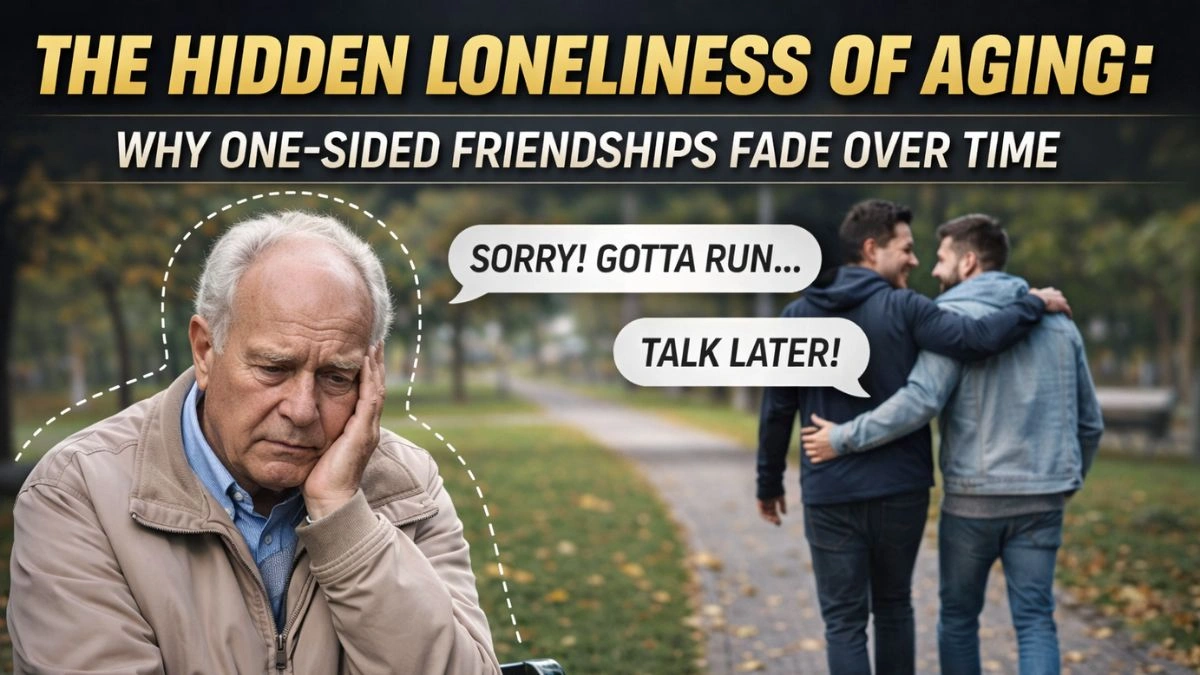
As people grow older, loneliness often takes on a deeper and more complex form. It is not always about being physically alone, but about realizing that some friendships quietly disappear when you stop putting in all the effort. Psychology suggests that this realization can be one of the most painful aspects of aging.
The “Quiet Fade” in Friendships
Many individuals eventually try a simple test: they stop initiating conversations, making plans, or checking in. What follows is often silence. Days turn into weeks, revealing that some relationships only existed because one person kept them alive.
This gradual disappearance—without conflict or closure—can feel more isolating than a clear ending, as there is no defined moment to process or explain.
Loneliness vs. Being Alone
Research shows that loneliness is not the same as solitude. It is defined as the gap between the relationships people want and what they actually experience.
- Around 24% of adults aged 65+ are socially isolated
- About 43% of people over 60 report feeling lonely
These figures highlight how widespread emotional disconnection can be, even when people are not physically alone.
The Overlooked Grief of Losing Friendships
Unlike other losses, fading friendships are rarely acknowledged as grief. There is no argument or goodbye—just a slow realization that the bond was one-sided.
Researchers have noted that studies often emphasize the benefits of friendships but pay less attention to imbalances, disappointment, and emotional strain, which are equally real.
Understanding the Psychology of Fairness
A key concept in relationship dynamics is equity theory, which suggests that people feel more satisfied when effort is balanced over time.
In friendships, contributions are often invisible, such as:
- Remembering important dates
- Offering emotional support
- Initiating plans and conversations
When one person consistently carries this emotional load, the relationship can begin to feel like a responsibility rather than a mutual connection.
How Common Are One-Sided Friendships?
Research indicates that uneven friendships are more common than many assume. A study analyzing social networks found that only about 53% of friendships are truly mutual.
This means nearly half of relationships may involve one person feeling closer or more invested than the other. Such imbalances often become visible when effort stops.
Why It Hurts More With Age
In younger years, friendships are often maintained through shared environments like school or work. Regular interaction helps sustain connections even when effort is uneven.
As people age, these structures fade due to:
- Retirement
- Health challenges
- Relocation
- Family responsibilities
At this stage, friendships survive only through intentional effort. According to socioemotional selectivity theory, older adults prioritize meaningful relationships, making the loss of one-sided connections feel more significant.
The Real Key to Emotional Well-Being
Studies consistently show that the quality of friendships matters more than quantity. Strong, supportive relationships are linked to improved mental health and overall well-being.
Long-term research also highlights the serious impact of loneliness, comparing its health risks to major factors like smoking or alcoholism.
What This Means in Real Life
When communication fades and effort is no longer returned, it can be tempting to take it personally. However, psychology suggests that this moment reveals an important truth:
Some relationships are built on mutual care, while others depend on one person’s continuous effort.
Recognizing this difference can be difficult, but it is essential for emotional clarity and growth.
Conclusion
The deepest loneliness in later life is not simply about having fewer people around—it is about understanding which relationships were truly reciprocal. As social circles shrink and priorities shift, the value of genuine, balanced friendships becomes clearer. Letting go of one-sided connections, while painful, can open space for more meaningful and emotionally supportive relationships.